




Silica Sol vs Water Glass Investment Casting
Silica Sol vs Water Glass Investment Casting: Which Process Do You Actually Need?
Investment casting (also called lost-wax casting) covers two main binder systems. Silica sol Investment Casting uses colloidal silica as the ceramic shell binder, producing CT4–CT6 tolerances per ISO 8062 and Ra 1.6–6.3 μm surface finishes in stainless steel, aluminum, copper, and nickel superalloys. Water glass (sodium silicate) investment castinghardens chemically, producing CT6–CT9 tolerances and Ra 3.2–12.5 μm finishes at 30–80% lower cost, mainly for carbon steel, alloy steel, and cast iron. Choose silica sol for precision, reactive alloys, thin walls, and smooth as-cast surfaces; choose water glass for larger carbon-steel parts where tolerance and finish are not critical.
That's the short answer. After twenty-plus years running both lines, the longer version is what usually saves buyers money, because the right choice depends on material, tolerance, size, and total delivered cost, not just the casting price.
Definitions
Silica sol investment casting(also called colloidal silica or "silica sol lost-wax casting") is a precision investment casting process in which the ceramic shell is built using a binder of nano-scale silica particles suspended in water. The shell air-dries over 7–14 days and contains almost no sodium, making it compatible with reactive alloys. It is the standard process for CT4–CT6 Precision Castings.
Water glass investment casting (sodium silicate or "water glass shell casting") uses sodium silicate (Na₂O·nSiO₂) as the shell binder. Each coat is chemically hardened in an ammonium chloride bath, so the shell builds in 3–7 days at lower material cost. The sodium content limits its use on stainless and reactive alloys. It is typically rated CT6–CT9.
Process Flow Comparison
The lost-wax sequence (wax pattern → shell → dewax → pour → knockout) is identical. The difference sits in the shell room.
| Stage | Silica Sol | Water Glass |
|---|---|---|
| Binder | Colloidal silica, no sodium | Sodium silicate, contains sodium |
| Face coat | Zircon flour / fused silica + silica sol | Quartz flour + water glass |
| Backup coats | 4–8 coats, air-dried between | 3–6 coats, chemical harden dip between |
| Shell build time | 7–14 days | 3–7 days |
| Dewaxing | Steam autoclave 150–170°C, 6–8 bar | Same steam autoclave |
| Shell preheat | 900–1,100°C, high hot strength | 800–1,000°C |
| Cleaning | Shell breaks down cleanly | Can cling in deep passages; more blasting |
Tolerance and Surface Finish
This is where silica sol earns its premium, and where the numbers usually decide the conversation.
| Parameter | Silica Sol | Water Glass |
|---|---|---|
| Tolerance grade (ISO 8062) | CT4–CT6 (CT5 typical production) | CT6–CT9 (CT7–CT8 typical) |
| 50 mm feature | ±0.20–0.30 mm | ±0.40–0.55 mm |
| 200 mm feature | ±0.40–0.60 mm | ±0.80–1.10 mm |
| As-cast surface (Ra) | 1.6–6.3 μm (best ~0.8 μm) | 3.2–12.5 μm |
| Min. wall thickness | 0.5–1.0 mm (small); 1.5 mm production | 1.5–2.0 mm (small); 2.5–3 mm production |
| Machining allowance | 0.3–0.8 mm per face | 0.8–1.5 mm per face |
For a full breakdown of what each CT grade means across every size range, see our guide to investment casting tolerances and ISO 8062 CT grades.
The nominal grade tells part of the story. The scatter tells the rest. A water glass line can hit CT6 on a good small part, but across a hundred castings the spread is wider. Silica sol shrinks more predictably, which is why its process capability stays where automotive and precision buyers need it. For functional surfaces, a 200–300% Ra difference isn't cosmetic; it decides whether you polish the casting or machine it.
Material Compatibility
The sodium in water glass is the deciding factor here.
| Material | Silica Sol | Water Glass |
|---|---|---|
| Carbon steel (WCB, WCC, 1020, 1045) | ✅ Excellent | ✅ Excellent — cost-effective choice |
| Low-alloy steel (4140, 4340, 8620) | ✅ Excellent | ✅ Good |
| Stainless steel (304, 316, 310S, 17-4PH) | ✅ Excellent | ⚠️ Possible with barrier coat; surface defects common |
| Heat-resistant steel (HK30, 1.4848) | ✅ Excellent | ⚠️ Limited; surface reaction at high preheat |
| Nickel superalloys (Inconel 713C, 718, Mar-M247) | ✅ Standard choice | ❌ Not recommended |
| Aluminum (A356.2, 319, 2618) | ✅ Excellent | ⚠️ Pinholes/dross risk; finish inferior |
| Copper alloys (bronze, brass) | ✅ Excellent | ⚠️ Possible with special face coat |
| Cast iron / ductile iron | ✅ Good | ✅ Excellent |
These nickel superalloys are also the standard choice for automotive turbocharger turbine wheels, where surface integrity at 1,000°C is non-negotiable. For corrosive service, duplex stainless steel is another material that almost always runs on silica sol.
The rule I'd hand a buyer: carbon steel, alloy steel, cast iron on either route — price decides it. Stainless, aluminum, copper, nickel alloys, anything reactive: silica sol, don't argue yourself out of it. We've had customers try water glass on 316 to save money, then pay more in grinding and scrap. The math almost never works.
Size, Cost, and Lead Time
| Factor | Silica Sol | Water Glass |
|---|---|---|
| Typical weight range | 10 g – 50 kg | 100 g – 200 kg |
| Maximum practical | ~100 kg (special handling) | ~500 kg (large shells) |
| Raw casting price (carbon steel) | Higher | Lower (roughly 30–80% cheaper) |
| Total delivered cost (precision stainless/Al) | Often lower | Often higher (more machining + cleanup) |
| Total delivered cost (simple carbon steel) | Higher | Lower |
| First-article lead time (no machining) | ~35–55 days | ~30–45 days |
| Repeat order (steady production) | Similar | Similar |
The one mistake I see repeatedly is comparing raw casting prices. Water glass can come in 30–80% cheaper as a bare casting, but it carries more machining stock, rougher surfaces, and higher scrap on reactive materials. On a precision stainless or aluminum part, the silica sol casting often ends up the cheaper delivered part. On a simple carbon steel bracket with loose tolerances, water glass wins outright.
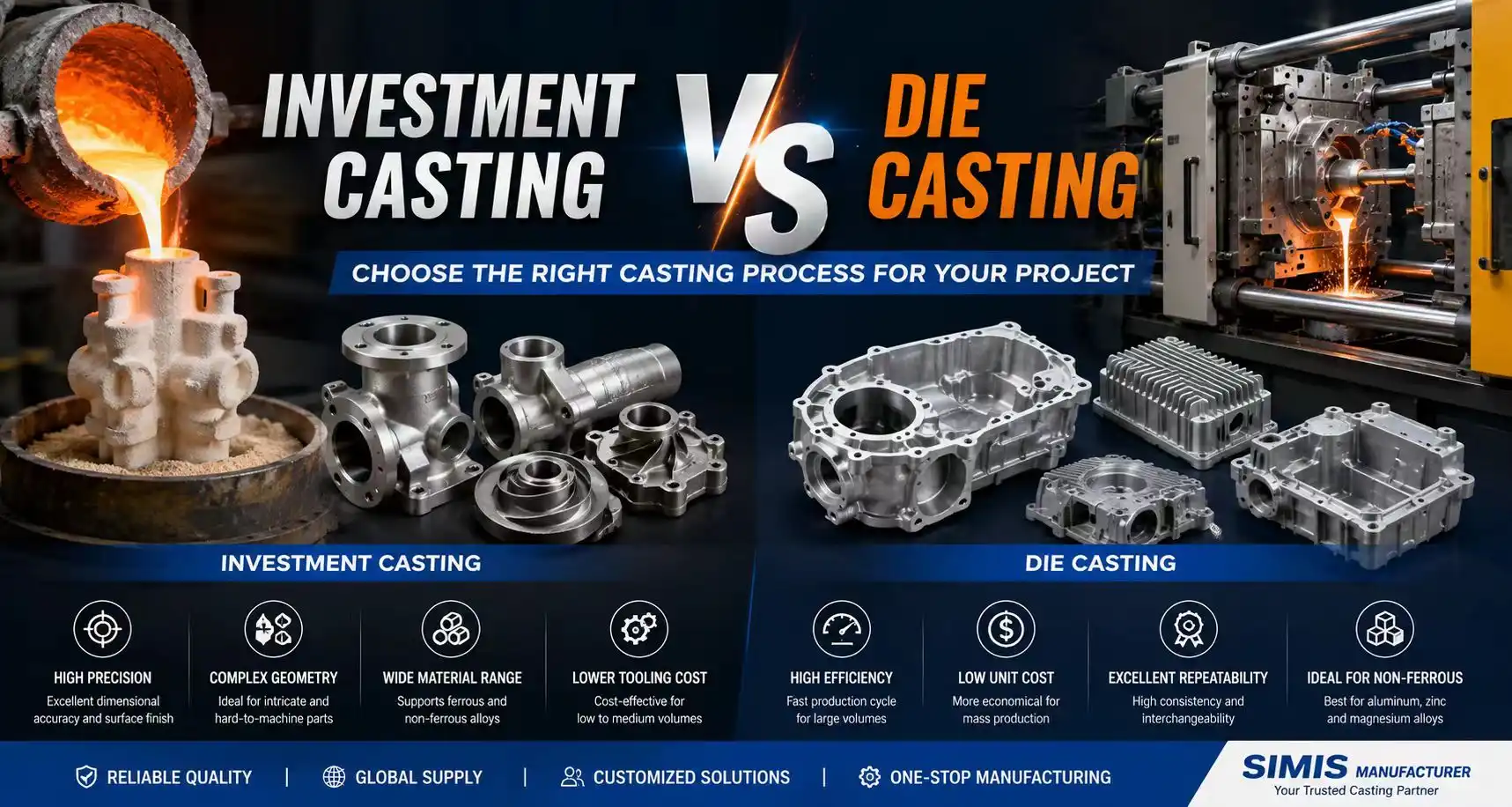
For high-volume aluminum work, it's worth comparing this against investment casting vs die casting — the cheapest total route depends on material and volume, not shell binder alone.
For prototypes under ten to fifteen days, skip both standard routes. 3D-printed wax on a silica sol shell avoids the hard tooling and gets you design-validation samples fast.
How to Choose: A Decision Table
When a buyer sends drawings, we run the same four questions in order.
| If your part is… | Choose… |
|---|---|
| Stainless, aluminum, copper, or nickel superalloy | Silica sol |
| Needs CT4–CT6 or Ra < 3.2 μm as-cast | Silica sol |
| Has walls thinner than 1.5 mm or fine detail | Silica sol |
| Small (< 5 kg) precision part | Silica sol |
| Carbon/alloy steel, generous tolerances | Water glass |
| Larger than 50 kg in carbon steel | Water glass |
| High-volume simple geometry, cost-sensitive | Water glass |
| Genuinely borderline | Quote both, fully delivered |
If it's CT6 on a small critical part, I lean silica sol for consistency. If it's a larger part with loose tolerances elsewhere, water glass under process control is fine. The honest move is to price both with machining and finishing included. Bare casting prices will mislead you.
Two Misconceptions Worth Clearing Up
"Silica sol is always better." Not on a 100 kg carbon steel counterweight at CT10 with no surface requirement. You'd be paying a shell premium for no functional gain.
"Water glass is low quality." It's a mature process that produces perfectly good carbon steel, alloy steel, and iron castings. The problems start when it's pushed into stainless, thin walls, or tight tolerances it was never designed for.
SIMIS Dual-Process Capability
We run both lines in-house, plus sand casting, die casting, and two CNC workshops. The reason that matters is that we're not a one-process shop trying to sell you our only product. When water glass is the right answer, that's what we quote.
- Silica sol line: stainless, aluminum, copper, nickel alloys; CT4–CT6; Ra 1.6–6.3 μm; 10 g to 50 kg; walls to 0.5 mm.
- Water glass line: carbon/alloy steel, cast iron; CT6–CT9; 100 g to 200 kg; high-volume production.
- In-house: CNC machining, heat treatment, and NDT inspection (X-ray, fluorescent penetrant, CMM).
For valve bodies and oil & gas pipeline components, this single-source control matters.
If you're still weighing suppliers, read our guide on how to choose the right investment casting manufacturer. Then request a free quote with your drawings. Our engineers will run a DFM review and tell you which process actually fits, with the realistic tolerance, machining requirement, and delivered cost. No hard sell — if the cheaper route wins, that's the answer.
FAQs
Q1: What is the difference between silica sol and water glass investment casting?
Silica sol uses colloidal silica binder with no sodium, giving CT4–CT6 tolerances and Ra 1.6–6.3 μm surfaces, ideal for stainless, aluminum, copper, and nickel alloys. Water glass uses sodium silicate binder that hardens chemically in 3–7 days at lower cost, but delivers CT6–CT9 tolerances and Ra 3.2–12.5 μm surfaces, mainly for carbon steel, alloy steel, and cast iron. The core difference is the binder, which drives tolerance, surface finish, material compatibility, and cost.
Q2: Which is more accurate, silica sol or water glass casting?
Silica sol. It holds CT4–CT6 per ISO 8062, typically CT5 in production, versus CT6–CT9 (CT7–CT8 typical) for water glass. More importantly, silica sol's dimensional scatter is tighter across a production run, giving higher process capability. For a 200 mm feature, expect ±0.40–0.60 mm on silica sol versus ±0.80–1.10 mm on water glass.
Q3: Can water glass investment casting be used for stainless steel?
Technically, with a barrier face coat, but it is not recommended for most applications. The sodium in water glass reacts with molten stainless at 1,500–1,650°C, causing burn-on, rough surfaces, and higher defect rates that require extra grinding. For 304, 316, 310S, 17-4PH, or any reactive alloy, silica sol is the standard choice.
Q4: How much cheaper is water glass than silica sol?
As a raw casting, water glass is typically 30–80% cheaper on carbon steel, driven by lower shell material and faster drying. However, water glass requires more machining allowance (0.8–1.5 mm vs 0.3–0.8 mm per face), more surface cleanup, and higher scrap on reactive materials. On precision stainless or aluminum parts, total delivered cost can actually be lower on silica sol.
Q5: What is the minimum wall thickness for each process?
Silica sol reliably produces 0.5–1.0 mm walls on small features, with 1.5 mm as a safe production minimum. Water glass typically needs 1.5–2.0 mm on small features and 2.5–3.0 mm in production. For thin fins, delicate ribs, or fine detail that must cast sharp, use silica sol.
Q6: Which process has shorter lead time?
Water glass, in shell building: 3–7 days versus 7–14 days for silica sol. That advantage narrows downstream because water glass parts need more cleaning and machining. Tooling is identical (20–30 days). For fastest prototypes, 3D-printed wax on a silica sol shell can deliver samples in 10–15 days without hard tooling.
Q7: Can the same wax die be used for both processes?
Usually yes, because the wax pattern is identical. However, shrinkage behavior differs between shell systems, so the die may need dimension adjustment to hold tight tolerances, and gating/risering may change. Always run a first-article approval on the new process before volume production.
Q8: How do I choose between silica sol and water glass?
Four questions in order: (1) Material — carbon/alloy steel or cast iron: either; stainless, aluminum, copper, nickel alloy: silica sol. (2) Tolerance/surface — CT4–CT6 or Ra < 3.2 μm: silica sol; CT7–CT9: water glass. (3) Size — over 50 kg in carbon steel: water glass. (4) Volume — high-volume simple geometry: water glass; low-to-medium precision volume: silica sol. When in doubt, price both with machining included.